





Richardson discusses the history of blacks in Cambridge, Maryland, where she is originally from, and their current economic situation. Richardson recounts how African Americans who live in Cambridge experience employment discrimination in that they are usually “the last hired and first fired.” As a result, many black workers are unable to achieve any kind of seniority in their jobs. Richardson discusses the split between the African American middle class and the laboring class in Cambridge. Most of the interview deals primarily with questions of “Negro identity,” her beliefs about nonviolence, and the destructive effects of segregation. She discusses how she handled the random violence during the St. Ann demonstrations in Cambridge when rocks were thrown at protesters. She disagrees with non-violence as a philosophy but not as a tactic.
Notes:
Audio Note: Richardson is somewhat faint throughout the interview, but she is much more audible than the transcripts make her appear.
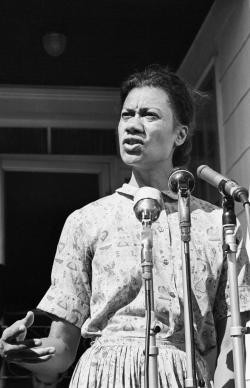
Image: Original caption: 10/2/63-Cambrdge, MD-Mrs. Gloria Richardson, chariman of the Cambridge Action Committee, is shown during her press conference today. Mrs. Richardson said that Negros will shift their integration drive to schools and industry, to give Cambridge officials a chance to come up with an alternative to the defeated Public Accommodations Law. Copyright: Bettmann/Corbis.
Audio courtesy of Yale University.
Gloria St. Clair Hayes Richardson
Gloria Richardson (born 1922) was a civil rights activist and leader of the Cambridge Movement in Cambridge, Maryland, in the 1960s. Richardson received a B.A. in sociology from Howard University in 1942. The Cambridge Movement began as a civil rights effort, with activists from outside the region and black Cambridge residents sitting in at segregated movie theaters, bowling alleys and restaurants. The movement evolved into a battle for the economic rights of Cambridge citizens, many of whom were faced with low wages and unemployment. She helped organize the Cambridge Nonviolent Action Committee, the only non-student-led affiliate of the Student Nonviolent Coordinating Committee. The Cambridge Movement's focus on social justice and its use of armed self-defense tactics have been cited as signaling the beginning of the Black Power phase of the civil rights movement. Richardson has worked for the National Council for Negro Women, Harlem Youth Opportunities Unlimited and Associated Community Teams, and the New York City Department for the Aging.
Image: Original caption: 10/2/63-Cambrdge, MD-Mrs. Gloria Richardson, chariman of the Cambridge Action Committee, is shown during her press conference today. Mrs. Richardson said that Negros will shift their integration drive to schools and industry, to give Cambridge officials a chance to come up with an alternative to the defeated Public Accommodations Law. Copyright: Bettmann/Corbis.
Transcript

TAPE 1 Searchable Text
Collapse[These digitized texts are based upon 1964 typed transcripts of Robert Penn Warren’s original interviews. Errors in the original transcripts have not been corrected. To ensure accuracy, researchers should consult the audio recordings available on this site.]
GLORIA RICHARDSON TAPE 1.
Cambridge, Maryland, March 2nd.
[00:00:25] WARREN: Mrs. Richardson, do you mind saying something about the local economic situation, I feel that town was moribund a few years ago, with 25 ________ closed, ________ effort to go out and bring in business, and this was quite successful. What’s the situation now, or is this true what I’ve been told?
RICHARDSON: Yes, I, this is ________ this is a one company town ________.
[00:01:13] Q: Now when was this please?
A: This was back in the thirties.
[00:01:17] Q: Oh, a long time ago.
A: And sometimes in the ________.
(CAN’T HEAR MRS. RICHARDSON)
Collapse
TAPE 2 Searchable Text
Collapse[These digitized texts are based upon 1964 typed transcripts of Robert Penn Warren’s original interviews. Errors in the original transcripts have not been corrected. To ensure accuracy, researchers should consult the audio recordings available on this site.]
GLORIA RICHARDSON TAPE 2
[00:00:15] Q: Let me turn to the matter of the near riots in Jackson, Mississippi, Jackson College. By a common report, Mr. Evers in the middle of the disturbance, worked to get the students back off the streets, and succeeded. Now you were saying to me earlier, that you felt that this method had dangers for future demonstrations had a dangerous effect on the white expectations about it. Would you explain that to me?
A:
(CAN NOT HEAR MRS. RICHARDSON)
Collapse

